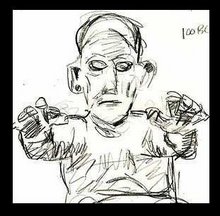
From Nathan Gill's "Clarity"
“There does not need to be any kind of ‘event’ associated with the recognition of our true nature. Well, as it happened, in September 1998 an event arose. I was gardening and the rain was drizzling down. I looked up, and there was a subtle sense of ‘me’ not being there. I got on my bike and cycled around the lanes and it seemed as though there was a movie going on, without any effort necessary on my part to be taking part in it. With this sudden dropping of the ‘I’, all need for understanding fell away as knowing was revealed.”
First a confession. I became irritated and upset the other day at work when someone purposely or purposely on accident, would not respond to my questions. I think I was justifiably upset because of the inconvenience, But something about that just "pushed my buttons".
Well we got over it, but it took a while to figure out why I was REALLY so upset. I think it was my ego. By not paying attention to me they were diminishing "my" worth and and ego HATES that kind of stuff. Most work conflicts I immediately recognize as of little real importance and can keep my perspective. But this one seemed worse.
As I stewed about the disrespect to me and my surprising internal sensitivity, I finally realized I was dragging this act with me all the time. I couldn't let go of the past.
Then I remember Nathan Gill's story about how with "dropping of the ‘I’, all need for understanding fell away as knowing was revealed."
Last year my thought was that there is only NOW, and we are all living in the NOW and the constant worry about the past and the future was just stuff we keep projecting in our brains during the NOW. And that is what I was doing. My ego was constantly replying this disrespect and it take on a life of its own.
Just remembering that story a bit of the ego, the "I" dropped away and my muscles relaxed. Not dramatically like Gill, but still it was something I could feel.
And I think most of society is like that. We are all a bunch of wounded egos running around upset because somebody disrespected us or our team, be that a political team, sports team, or religious team. So to drop the "I" you drop ego, and without ego there is nothing to offend.
So to calm down, my mantra is : There is no "I" there is only NOW!
11/23/2019


10/10/2019
Tapleyism
Tapleyism
PRONUNCIATION: (TAP-lee-i-zuhm)
MEANING: noun: Extreme optimism, even under most hopeless circumstances.
ETYMOLOGY:After Mark Tapley, a character in Charles Dickens’s Martin Chuzzlewit (1843-44). Earliest documented use: 1857.
PRONUNCIATION: (TAP-lee-i-zuhm)
MEANING: noun: Extreme optimism, even under most hopeless circumstances.
ETYMOLOGY:After Mark Tapley, a character in Charles Dickens’s Martin Chuzzlewit (1843-44). Earliest documented use: 1857.
8/20/2019
Cat Tracking
Cat Tracking
Where the Hackaday Cat goes when she steps over the threshold into the wider world is a mystery, she reveals her whereabouts strictly on her terms and would we suspect be very cagey were we able to ask her about it. [Andy C] however has a need to know where his cat is spending her time, so he’s made a GPS collar for a bit of feline spying.
There are commercial GPS collars for pets, but they all share the flaw of extremely limited battery life. His challenge then was to create a collar that delivered the required pinpoint fix alongside a battery life measured in months. The solution was a combination of a low-power miniature GPS receiver and a low-power PC microcontroller hooked up to an FSK radio whose frequency he doesn’t give but which we suspect is probably the usual 433 MHz. The collar remains in low power mode until it receives a call on the FSK, at which point it wakes up, gets a GPS fix, transmits it, and returns to sleep.
The summary links to a series of posts which provide an extremely detailed look at all aspects of the project, and go well beyond mere GPS trackers for a cat. If you have an interest in low power devices or antenna matching for example, you’ll find a lot of interesting stuff in these pages. Of course, if all you need is a GPS tracker though, you may prefer a simpler option.
https://hackaday.com/2018/08/28/wheres-the-cat-locating-your-moggy-without-eating-batteries/
7/15/2019
How to Write a Story - thank you Doc Savage
Michael Moorcock's Summary of Lester Dent's Method
I'll get to a blow-by-blow of Dent's method shortly but here's a summary, courtesy of Michael Moorcock:
"... split your six-thousand-word story up into four fifteen hundred word parts. Part one, hit your hero with a heap of trouble. Part two, double it. Part three, put him in so much trouble there's no way he could ever possibly get out of it. ... All your main characters have to be in the first third. All your main themes and everything else has to be established in the first third, developed in the second third, and resolved in the last third. (Lester Dent, Wikipedia)"
Note: When I talk about Dent's method, below, much of it is a paraphrase.
http://blog.karenwoodward.org/2013/11/lester-dents-short-story-master-formula.html
https://mgherron.com/2015/01/lester-dents-pulp-paper-master-fiction-plot-formula/
https://mgherron.com/wp-content/uploads/2015/01/lester-dents-formula-printable.pdf
7/07/2019
Reading Cat's Cradle by Kurt Vonnegut
From "Cat's Cradle"
“Tiger got to hunt, bird got to fly;
Man got to sit and wonder 'why, why, why?'
Tiger got to sleep, bird got to land;
Man got to tell himself he understand.”
― Kurt Vonnegut, Cat's Cradle


“Tiger got to hunt, bird got to fly;
Man got to sit and wonder 'why, why, why?'
Tiger got to sleep, bird got to land;
Man got to tell himself he understand.”
― Kurt Vonnegut, Cat's Cradle


5/13/2019
Experts, Smexperts!!
I just wanted to bookmark this interesting article
As the Danish proverb warns, “It is difficult to make predictions, especially about the future.”
Comparing experts as "hedgehogs" or experts with deep knowledge of their field to "foxes" people with a wide range of interests
In Tetlock’s 20-year study, both the broad foxes and the narrow hedgehogs were quick to let a successful prediction reinforce their beliefs. But when an outcome took them by surprise, foxes were much more likely to adjust their ideas. Hedgehogs barely budged. Some made authoritative predictions that turned out to be wildly wrong—then updated their theories in the wrong direction. They became even more convinced of the original beliefs that had led them astray. The best forecasters, by contrast, view their own ideas as hypotheses in need of testing. If they make a bet and lose, they embrace the logic of a loss just as they would the reinforcement of a win. This is called, in a word, learning.
https://www.theatlantic.com/magazine/archive/2019/06/how-to-predict-the-future/588040/
3/17/2019
Note to Self: How to get subtitles from a BluRay or DVD (that you legally own!)
Next Day UPDATE:
It turns out I was using the wrong tool I wanted
MKVCleaver x64
I setup a RaspberryPi as a Plex video server and converted all my DVDs and BluRays to MP4s. I don’t have a huge library but still enough to be a bit of a task.
The problem is Foreign films, and how to get the English subtitles to show up.
In case you don’t know, to save BluRay discs to a file you need MakeMKV and HandkBrake. And to get subtitles you need MKVextract, which gives you two files one with a .sub suffix and an .idx siffix. If you have this type of subtitle result yo just need to put them in the same folder as the MP4 of the moving and then add the subtitle track in the PLEX setup of that movine.
HOWEVER, for some reason some BluRays export as .sup files and these just don’t work with the PLEX server.
After a couple of attempts I found my answer was to use Subtitle Edit which needs the movie in mkv format but can read through the movie and use OCR (optical character recognition) to confert the image based sup file to the text based srt file. The PLEX server is cool with srt files, so the only wrinkle is the quality of the pictures of the subtitles will cause it to throw that part up and ask you to type it in.
I think if the disk is a quality manufacturer you may have to respond to a dozen or so problems in the OCR process. Not to bad really. But on a cheap production you might have to retype the whole movie.
And if you have a DVD you just need to use MakeMKV rather than Hanbrake (with the VLC mod) since MKVextract only works on MKV files. After you have the subtitle files you just run the mkv file through Handbrake and you are done
MKVextract & gMKVextractGUI & MKVToolNIX
https://mkvtoolnix.download/doc/mkvextract.html
https://mkvtoolnix.download/downloads.html
https://sourceforge.net/projects/gmkvextractgui/
https://www.makemkv.com/
Registration Key for makemkv beta
https://www.makemkv.com/forum/viewtopic.php?t=18441
https://handbrake.fr/
VLC libdvdcss.dll for Handbrake
https://www.videolan.org/developers/libdvdcss.html then look for “releases” link…
https://www.videolan.org/developers/libdvdcss.html
The latest one for windows is ver 1.2.12
https://download.videolan.org/pub/libdvdcss/1.2.12/
UPDATE:
My MKVextract wasn't working (not sure if it was just the one Blue ray so I had the mkv file but used Inviska MKV Extract on it. Then used Subtitle edit
Next Day UPDATE:
It turns out I was using the wrong tool I wanted
MKVCleaver x64
Although it delivered a sup file which subtitle edit had problems with, so that finally I found a website that had an srt file that worked
It turns out I was using the wrong tool I wanted
MKVCleaver x64
I setup a RaspberryPi as a Plex video server and converted all my DVDs and BluRays to MP4s. I don’t have a huge library but still enough to be a bit of a task.
The problem is Foreign films, and how to get the English subtitles to show up.
In case you don’t know, to save BluRay discs to a file you need MakeMKV and HandkBrake. And to get subtitles you need MKVextract, which gives you two files one with a .sub suffix and an .idx siffix. If you have this type of subtitle result yo just need to put them in the same folder as the MP4 of the moving and then add the subtitle track in the PLEX setup of that movine.
HOWEVER, for some reason some BluRays export as .sup files and these just don’t work with the PLEX server.
After a couple of attempts I found my answer was to use Subtitle Edit which needs the movie in mkv format but can read through the movie and use OCR (optical character recognition) to confert the image based sup file to the text based srt file. The PLEX server is cool with srt files, so the only wrinkle is the quality of the pictures of the subtitles will cause it to throw that part up and ask you to type it in.
I think if the disk is a quality manufacturer you may have to respond to a dozen or so problems in the OCR process. Not to bad really. But on a cheap production you might have to retype the whole movie.
And if you have a DVD you just need to use MakeMKV rather than Hanbrake (with the VLC mod) since MKVextract only works on MKV files. After you have the subtitle files you just run the mkv file through Handbrake and you are done
MKVextract & gMKVextractGUI & MKVToolNIX
https://mkvtoolnix.download/doc/mkvextract.html
https://mkvtoolnix.download/downloads.html
https://sourceforge.net/projects/gmkvextractgui/
https://www.makemkv.com/
Registration Key for makemkv beta
https://www.makemkv.com/forum/viewtopic.php?t=18441
https://handbrake.fr/
VLC libdvdcss.dll for Handbrake
https://www.videolan.org/developers/libdvdcss.html then look for “releases” link…
https://www.videolan.org/developers/libdvdcss.html
The latest one for windows is ver 1.2.12
https://download.videolan.org/pub/libdvdcss/1.2.12/
UPDATE:
My MKVextract wasn't working (not sure if it was just the one Blue ray so I had the mkv file but used Inviska MKV Extract on it. Then used Subtitle edit
Next Day UPDATE:
It turns out I was using the wrong tool I wanted
MKVCleaver x64
Although it delivered a sup file which subtitle edit had problems with, so that finally I found a website that had an srt file that worked
Subscribe to:
Posts (Atom)