Showing posts with label Books. Show all posts

5/25/2025

First Time Book Repair

The Omnibus of Crime with Dorothy L. Sayers - (Editor)

Front and back boards of the book had pulled away and the linen (mull) exposed on bot. The Spine with the graphic was detached on one side exposing the spine of the book block.

It was a heavy book so likely any further reading would cause the boards to tear off completely and the edge graphic to fall off.

There are many YouTube videos with different techniques but combining a few I opted to replace the hinge (replace the linen mull) with "binder tape".

Then use a similar color book cloth to cover the spine attach to the boards.

Here are all the pieces of the puzzle
Replace hinge ingredients
  • Single stitched binder tape 1 1/2 inch
  • Allure Bookcloth Black
  • spine stiffener - 10 point paper
  • PVA
  • Bone Tool
  • knife and/or paper cutter
The final result below.

I suspect a master book repair person would dislike this method, since they would have replaced the end papers and used new "mull", the linen mesh that goes across the text block spine, and is glued to the endpapers which is then glued to the front and end boards. I have the book cloth spine maybe a 1/8 to 1/16 too high on the spine, that in no affects how it sits on the shelf and most people won't notice (I thing and hope)

BUT that was beyond my skil level, and from what I gather by watching you tube videos, this is what a library might use for "reading volumes" not collectibles. This particular book was actually a first edition from 1929, but I found multiple first editions of this title in the $20+ range on ebay so I didn't feel too bad about this more direct method.

In the end it feels really solid and should give years of reading pleasure.

12/09/2023

The Time I Tried to Read a Mark Levin Book

I tried to read Mark Levin's The Democrat Party Hates America and made it maybe half way through before I switched over to hyper-drive reading speed. Not because it was so easy to go through, but because every page is overflowing with venom and hatred, hatred of the “the Democrat Party”, of Joe Biden, of Hunter Biden...pure, pulsating hatred. I just wanted get through it as fast as possible. But even then I had to quit before the end of the book. It was just too depressing.

I thought it would be a good exercise to get out of my comfort zone and see another point of view. I thought I would examine his logic and admit where I saw it as...well ,logical, and point out where there was poor reasoning (as I saw it). But really after getting into it, I don’t remember any actual arguments, just an avalanche of hateful rhetoric directed at “the Democrat Party”. And if you didn’t know, calling the Democratic Party “the Democrat Party” is meant to be an insult, or it is when you hear it spoken and that same tone comes across in this book.

I probably overvalue my own skill at analyzing arguments. But this was an exercise for me, and nobody else will likely read it my thoughts, so I plunge ahead with my own limited abilities.

Anyway, it wears you down putting your mind in the mind of somebody so very angry, so filled with the opposite of compassion. Page after page of saying the current state of the country is horrible, really horrible, but really he “tells” and doesn’t “show” us about that.

The upshot is IF you already think the Democrats are really bad I bet you are fine with believing they are all Marxist. Yet he never defines what he means so I assume he thinks social secruity, laws protecting minorities, any acknowledgment of prejudice..THAT is Marxist. I mean if Marxism means the state owns the means of production then none of that stuff is actually Marxist.

Assuming he equates Marxism with Communism, he never shows where Democrats are trying to obolish private property, much leess have the state take over the means of production (BTW, take over is not the same thing as to regulate)

So he goes on and on about how Democrats are Marxist. Then there are some really long sections where he repeatedly tells us "you know who really liked slavery in the 19th century??..DEMOCRATS...And you know what else, guess who was really racist after the Civil War...DEMOCRATS. So THERE. " I mean yeah, but the unstated conclusion is that all Democrats today therefore also believe in all that stuff. And that goes on and on for multiple chapters and he is really indignant about it. So really super disingenuous reasoning for page after page is simply draining, it is so disingenuous it is hard to even know where to start.

And YES I know Woodrow Wilson was super racist, EVERYBODY knows that. But it doesn’t dissuade me from voting for a stronger social safty net or anything that would make rich people pay more in taxes. Another unstated assumptions is that taxation is marxism.

And the Coup de grâce is the last chapter where he talks about the worst thing that has ever happened in America...attempts to save lives by implementing COVID lock downs. If you come to this book already thinking like him then no reasoning is required. If you think the lock downs were a tool people tried to make things better, and we should look at what worked and what didn’t for the next time, then Levin is of no help. Although I have to admit I skippped most of the last chapter for my mental health, but from the tone of the opening I am pretty sure he did not work out a nuance position.

Below are some highlights I saved from the library ebook I checked out. Remember he is saying the stuff below about Democrats. I guess during his schooling his dictionary had no entry for “irony”

And of course the biggest irony is that with half or more of the population voting for the Democratic Party he is the one who really, really, hates America. Or at least 1/2 of it

# #
The police state is growing—as is monitoring and spying
the police state is growing (elsewhere he says police budgets are slashed??)
Our borders are wide open
The Democrat Party is responsible
eviscerate the Constitution
Democrat Party apparatchiks
Biden’s radical agenda
American Marxism
the progressive left who hate America
the American Marxist agenda,
their “Marxist paradise.”
Democrat Party today is more Leninist than Jeffersonian
the horrendous story of the Democrat Party’s past
Wilson’s racism
American Marxism

No longer would states with smaller populations, rural areas, etc., have any effective say in the selection of presidents and vice presidents. Indeed, only nine states make up about 50 percent of the nation’s population. Thus, representative government, where all areas of the country have a say in the conduct of the national government, would end. Tens of millions of people would be without meaningful input in governmental affairs—most of whom just happen to be Republicans and Independents. Representative government would be over for tens of millions of American citizens.

Of course, slavery is unconscionable. There is no excusing it. But capitalism did not drive slavery. Slavery has existed, and exists today, throughout the world and in noncapitalist societies. As Peter W. Wood, president of the National Association of Scholars, explains: “Slavery… was not an American invention, or a European one. It has existed in human societies for thousands of years.

They have a totalitarian mind-set. This means the party must come before country

11/21/2023

If It Quacks Like Evil, Maybe It Really Is Evil

The Conspiracy to End America: Five Ways My Old Party Is Driving Our Democracy to AutocracyThe Conspiracy to End America: Five Ways My Old Party Is Driving Our Democracy to Autocracy by Stuart Stevens
My rating: 4 of 5 stars

I admit that at the start I was not dazzled by this new Stuart Stevens book. It had a lot of references and names and stories from the many other scary books about trump. I had read or heard mentions of these sources in print or on many podcasts and opinion stories. And it is true much of this is a rehash of what we already know.

So what is new here?

The background info he brings is fine but like I said if you were looking in this direction already you probably knew much of it. HOWEVER once Stuart comes out swinging for real, he really keeps coming. With a directness and force you didn’t realize you were missing. And really the facts are clear for any that have eyes and ears and with much force Stuart Stevens is shouting to get your attention.

Trump and Trumpism are as pure evil as has existed in mainstream politics, and when I look around, I, too, often see the institutions of America failing the moment. It doesn’t come in the active embrace of Trumpism but in a failure aggressively and unequivocally to reject an authoritarian movement of hate. My fear is that America is learning to accommodate Trumpism, and history is clear that is a gateway drug to democratic collapse. - Location 2284-2287

“Pure Evil” ? Is that too much?
I used to complain in my imaginary political dialogs with people who demonized previous Republican administrations or politicians. I mean sure I thought they were wrong and probably jerks, but that was as far as I would take it, BUT I think with the current situation his comment is not hyperbole. Again for those who have the eyes and ears to look a the facts.

To rise in the Republican Party, it is essential to show solidarity with those who wish to end democracy. - Location 2181-2182

He does have an outline of why he has his vies and they make sense of the obvious (to me) craziness of modern Republicanism

Whenever a democracy slides into autocracy, there are five critical elements at work. All of these are active today in American politics.

The five autocratic building blocks are:
•Propagandists
•Support of a major party
•Financers
•Legal theories to legitimize actions
•Shock troops

- Location 94-98

And he uses known facts and stories to show this is the case.

I wish I could sit and talk with him for a while and ask what he would have said about some of his current opinions that were anathema to Republicans just a short while ago before he was on this track. Like was he also so reasonable about guns?

Walking into a Starbucks with a semiautomatic weapon isn’t proving you have the right to bear arms; it is an assertion that you do not trust society to protect you, that there is no civil bond between you and the next person in line ordering a latte. - Location 2206-2207

And what did he previously think of the Federalist society in the “before times”? Because his take down of them is throughout and SO spot on it is scary. In fact I would say it is one of the core takeaway of the book. I suspect he was previously fine with the Federalist Society before and probably all the never Trump Republicans were totally cool with them. Or maybe not, I never get and chance talk with them

Here it is even if it is a bit long for a Goodreads review.

Taken individually, none of these judicial actions is a death blow to democracy, but collectively, each builds on the previous one. It is a long game played with patience. A timeline tells the story:

1982: The Federalist Society is formed.
1986: Federalist Society superstar Antonin Scalia is nominated to the U.S. Supreme Court by President Reagan.
1991: Clarence Thomas, a Federalist Society member, is nominated by George H. W. Bush. 2000: George W. Bush loses the popular vote to Al Gore but is elected by the electoral college. The Supreme Court rules 5–4 in favor of Bush in the infamous Bush v. Gore case. 2004: George W. Bush is reelected.
2005: Leonard Leo of the Federalist Society creates the Judicial Confirmation Network (later to become Judicial Crisis Network). He raises $15 million from undisclosed donors to run confirmation campaigns supporting Bush Supreme Court nominees.
2005: John Roberts, a Federalist Society member, is nominated to the Supreme Court by George W. Bush.
2005: Samuel Alito, a Federalist Society member, is nominated to the Supreme Court by George W. Bush.
2006: The Federalist Society expands its public relations campaign. Leo comments that “I spend probably close to $800,000 annually on a PR team at the Federalist Society, and we generate press that has a publicity value of approximately $146 million each year.”
2010: The Supreme Court rules 5–4 in the Citizens United decision that corporations have the right to spend unlimited money in U.S. elections. Four of the five deciding votes are cast by Federalist Society members.
2010: redmap is formed by Republicans to focus on redistricting state legislatures to maximize Republican benefit.
2012: With the help of undisclosed “dark” money made possible by Citizens United, conservative Paul Newby is elected to the North Carolina Supreme Court.
2012: North Carolina ends public financing of judicial nominations.
2013: The Supreme Court nullifies key provisions of the Voting Rights Act, which John Roberts first opposed in 1981.
2016: Justice Scalia dies seven months before the presidential election. Senate Majority Leader Mitch McConnell refuses to allow hearings or a vote on President Obama’s choice of Merrick Garland as Scalia’s replacement. McConnell says, “The American people should have a voice in the selection of their next Supreme Court justice. Therefore, this vacancy should not be filled until we have a new president.”
2016: Leonard Leo’s Judicial Crisis Network spends $7 million to support the Republican senators running for reelection who refuse to hold hearings on Merrick Garland.
2016–2017: Groups controlled by Leonard Leo raise over $250 million from undisclosed donors.
2016: Donald Trump loses the popular vote to Hillary Clinton by 2.8 million voters but wins the electoral college.
2017: Leonard Leo’s Judicial Crisis Network spends $10 million in support of Trump.
2017: Trump nominates Neil Gorsuch, a Federalist Society member, to replace Justice Scalia. 2017: Leonard Leo’s Judicial Crisis Network spends $10 million supporting the Gorsuch nomination.
2018: Justice Kennedy resigns. Trump appoints Brett Kavanaugh to replace him. Kavanaugh, a Federalist Society member, worked for the two George W. Bush campaigns and in the White House, married Bush’s long-time personal assistant, and was nominated by Bush to the United States Court of Appeals for the District of Columbia Circuit. Trump, a president who lost the popular vote, appoints the protégé of a president—Bush—who also lost the popular vote.
2018: The Leonard Leo organization “Freedom and Opportunity Group” donates $4 million to “Independent Women’s Voice,” which runs ads supporting Kavanaugh. Heather Higgins, the group’s president and chief executive, attacks the women who accuse Kavanaugh of sexual assault, saying, “If you have a weak standard of evidence, then what you are doing is guaranteeing that future nominations will all be last-minute character assassinations and circuses.” She is paid $311,000 annually as the leader of Independent Women’s Voice.
2019: The U.S. Supreme Court rules that states are free to gerrymander without review by the state’s Supreme Court. “We conclude that partisan gerrymandering claims present political questions beyond the reach of the federal courts.” Of the justices voting in support of the 5–4 ruling, three have been confirmed by a collection of senators who represented a minority of the country’s population. All are Federalist Society members.
2020: Justice Ruth Bader Ginsberg dies thirty-eight days before the presidential election. Trump appoints Amy Comey Barrett to replace her. Majority Leader McConnell holds hearings and the Senate vote to confirm her after the presidential election voting has begun in many states. He denies this contradicts his previous refusal to hold hearings on the Merrick Garland nomination during an election year.
2020: Barrett is confirmed and becomes a justice of the Supreme Court. There have been five Supreme Court justices in U.S. history who were appointed by a president elected with a minority of the vote and confirmed by senators representing a minority of the country’s population. With Barrett’s confirmation, all five are currently on the Supreme Court.
2022: $1.6 billion is gifted to the Marble Freedom Trust, a Leonard Leo group.
2023: The North Carolina Supreme Court overturns a previous ruling and allows the Republican-controlled legislature to draw districts by any guidelines they choose.

The 2019 Supreme Court ruling on gerrymandering provides no pathway for appeal. Justice Paul Newby, who was elected post–Citizens United, is now chief justice. What began decades earlier continues to play out, changing the legal basis of American elections. It is the Long Game played patiently and relentlessly with no like effort in opposition. The Republican attack on the electoral system with combined efforts to challenge election results, restrict voting, and control the counting of votes is following the successful blueprint used by the Federalist Society to change the judicial system.

Location 1794-1848

Thanks to NetGalley for letting me get a head start of this important book

View all my reviews

12/02/2020

The Episode Where We Escape From Freedom

I have been reading Erich Fromm's Escape from Freedom recently, and to fill in some blanks I went looking for some background on Fromm on the Internet.

Nice Quote

Fromm identified deep feelings of anxiety and powerlessness upon which Hitler had been able to capitalize. His sadomasochistic message of love for the strong and hatred for the weak — not to mention a racial program that raised “true-born” Germans to the pinnacle of the evolutionary ladder — provided a means of escape from intolerable psychological burdens experienced on a mass basis.

Escape From Freedom was not merely an analysis of Nazism. At the heart of its thesis was the notion that capitalism — particularly in its monopolistic phase — fostered “the development of a personality which feels powerless and alone, anxious and insecure,” and which is therefore tempted to surrender its freedom to strongman leaders.


https://www.jacobinmag.com/2020/08/erich-fromm-frankfurt-school-marxism-weimar-germany

1/26/2018

As If Anything Matters Anymore

Choosing Donald Trump: God, Anger, Hope, and Why Christian Conservatives Supported HimChoosing Donald Trump: God, Anger, Hope, and Why Christian Conservatives Supported Him by Stephen Mansfield
My rating: 3 of 5 stars

It’s an odd book. I appreciate Mansfield’s honesty about what Trump is, and how he accurately portrays his fellow conservative Christians. He pulls no punches, well maybe a few, but overall he doesn’t shy away from Trump’s character flaws, moral failings, and general horrible behavior.

It is odd because with no explanation he implies Trump is a good thing. Oh wait, this may take a while so let me give a condensation of his accurate presentation...

Trump is a horrible, horrible, person and the religious leaders are hypocritical horrible, horrible people too. And the one ring that binds them all is the fiery ring of anger. Everybody is really pissed and conservatives Christians revel is their anger and scream to drink in Trumps venomous rantings Really not that complicated and he convinced me. Although Mansfield might phrase it somewhat differently.

But first. THINGS I WANT TO GET OFF MY CHEST…

The guy is a little irritating in that he writes as if he is being even handed, but he ain’t.

He HATES Hillary Clinton...

With virtually no evidence, after acknowledging her religious bone fides he rates how real her Christian faith is (amazing insight he has into another human’s soul). He makes some weak arguments about a supposed seance she participated in while first lady (we have to forget about Nancy Reagan and bringing an Astrologer in regularly) . Pretty bad huh?

Except the author has never hear about snopes.com. Yeah there some screwy imaginative therapy, but no communing with the dead. Anyway he parlays this into “The truths of her Methodist upbringing were no longer enough”. Pg 120. What does that even mean? He never says, but he implies it is pretty bad.

“Her advocacy for abortion knows no bounds….the most outspoken about her faith and the least clear about the meaning of that faith. It is possible to wonder if her religion was nothing more than mystical justification for whatever she wanted to do. Did she have any ethical content? Pg 122

Jiminy Cricket, knowing what he knows about Trump, how can he criticize Hilary's religious commitment with a straight face? I haven’t even come to his accurate demonstration of Trump’s lack of religious knowledge and how he contradicts almost every conventional Christian traditions. The old ones that I remember like humility, compassion, patience, forgiveness, and even love of neighbors. Of course most Christians don’t follow these models, but the point is Trump does the exact opposite!

He should have just laid the pro-choice label on Hilary and say it is a Christian deal breaker even though otherwise the evidence shows that she is pretty damn good Christian by any objective standard. And that is really what rubs Mansfield and the rest of Conservative Christian world the wrong way, Abortion (and he gets some digs in about gay marriage). If you are pro-choice you are a relentless, leftist, socialist, and that cannot be allowed at all.

Later he makes a big deal about Hilary/Obama having a litmus test for Abortion and if you are against abortion you are somehow a "target" of Obama. But he doesn’t see that he and his world are the ones with the litmus test with the difference that if we use his test he gets to tell me how to live, but if we use my litmus test, I don’t tell anybody what to do. So who is the one imposing their will on whom? And if you are pro choice you are one big evil target.

MANSFIELD’S PROOF OF HOW TRUMP IS A HORRIBLE, HORRIBLE PERSON

“I realized then and there,” he later recalled, “ that if you let people treat you how they want, you’ll be made a fool. I realized then and there something I would never forget: I don’t want to be made anybody’s sucker.” Pg 52.

TRUMP speaking... “man is the most vicious of all animals, and life is a series of battles ending in victory or defeat. You just can’t let people make a sucker out of you” Pg 63

In 2005...He told the audience that he “loved losers because they make me feel so good about my self” He also insisted that good business leaders should trust no one, good employees in particular. “Be parnoid,” he advised “because they are gonna try to fleece you.” Finally, he counseled, “Get even. If somebody screws you, screw ‘em back ten times over. At least you can feel good about it. Boy, do I feel good.” Pg 69

[F]or at least the first five decades of [his] life, there was little evidence of a defining Christian Faith. Instead, his religion was power, vengeance, and, notably himself. He seemed not to know that the ideal of revenge to which he devoted so much time and an entire chapter of a book was contrary to the teaching of the religion he served. He did not know or did not care that truth mattered in his faith, that his preference for "truthful hyperbole"—an"innocent form of exaggeration . . . and a very effective form of promotion"—was little more than lying and forbidden by his religion. It was the same with his sexual mores, with his language, and business ethics, and with his lack of evident concern for the will of an all-knowing God. (Pg. 70).

Colonel Theodore Dobias..spoke words he thought would ignite character and passions in Trump’s soul....Dobias also made him an unofficial basketball coach. ….[Trump] ..recalls mainly that he learned how to manipulate Dobias to get what he wanted. Pg. 52


All in all a ton of stories and they are pretty much all bad.

There was more stuff with straw men arguments about cake decorators and Hobby lobby dictating their religion on their employees (you probably know he can’t see a contradiction that he thinks it is Obama who is persecuting all of them and not the employer persecuting the employees and customers). I could buckle down and dissect his sentences to show how it is fallacious, or point out how half of his listing of Trump’s successes went on to be failures...but what is the point.

Still...he comes up with a pretty good insight...

The truth is that much of the appeal of Donald Trump is the way he speaks publicly in the same way millions of Americans do ...Crass, insulting, bullying, sometimes ill informed, always opinionated, usually prejudiced, Donald Trump is the private voice of millions of Americans. Pg 126

The evangelicals are really angry and are drawn to Sith Lord anger of Donald Trump. So he again correctly sees that Trump is horrible person and the people who like him are just like him

And somehow he inexplicably comes to this conclusion...

To the extent that the Trump presidency is built upon eternal principles and timeworn truth, it may accomplish noble things. Pg. 161

But right after that he includes this H.L. Menken quote

The Presidency tends, year by year, to go to such men. As democracy is perfected, the office represents, more and more closely, the inner soul of the people. We move toward a lofty ideal. On some great and glorious day the plain folks of the land will reach their heart’s desire at last, and the White House will be adorned by a downright moron. HL Mencken. Pg 162

I guess it boils down to Mansfield is a conservative Christian so he has to accept Trump as the savior of the country....Go figure.

Oh yeah, he really hates Obama also, so I would be kind of scared to see his book on Obama's faith.

View all my reviews

1/06/2018

Download Kindle Book Notes

I only just now found out of a way to download all kindle highlights and notes. Previously I would open the app on my laptop, open the notes and copy them out one at a time.

this has a browser add on but really the line is the best part

https://www.norbauer.com/bookcision/

https://read.amazon.com/notebook

1.Drag the above button to your browser's bookmarks bar.
2.Log in at read.amazon.com.
3.Click on a book title.
4.When the book's page has loaded, click on the "Bookcision" link in your browser's bookmarks bar.
5.An overlay will load with just your highlights.

If you are running Chrome, you'll see an option to download your highlights in various formats. Otherwise, just copy and paste

10/26/2017

We Have Met the Enemy and He is Us

The Fire Next TimeThe Fire Next Time by James Baldwin
My rating: 4 of 5 stars

What is this book? I cannot describe it. Of course he writes about race and about white America, and about freedom, injustice, and pain. But how could I comment or add to that? It is a challenge for a slow witted middle aged white man to say anything much less come to any conclusions from this book by James Baldwin. But don’t worry, I have no conclusion, no pronouncements…but I am human and I will, with trepidation, offer some observations.

First off the obvious, almost too obvious, when I went to copy out parts I wanted to quote I could have just kept typing and retyped the whole book. And there is some flat out “heavy” thinking going on in here, really “deep” stuff. A

Behind what we think of the Russian menace lies what we do not wish to face, and what white Americans do face when they regard a Negro: reality - the fact that life is tragic. Life is tragic simply because the earth turns and the sun inexorably rises and sets, and one day, for each of us, the sun will go down for the last, last time. Perhaps the whole root of our trouble, the human trouble, is that we will sacrifice all the beauty of our lives, will imprison ourselves in totems, taboos, crosses, blood sacrifices, steeples, mosques, races, armies, flags, nations, in order to deny the fact of death, which is the only fact we have. It seems to me that one ought to rejoice in the fact of death – ought to decide - indeed, to earn ones death by confronting with passion the conundrum of life. Pg. 91

Like I said this is some deep stuff. His analysis from 1962 is sadly still pretty spot on.

It is so simple a fact and one that is so hard, apparently, to grasp: Whoever debases others is debasing himself. That is not a mystical statement but a most realistic one, which is proved by eyes of any Alabama sheriff...Pg. 83

...In any event, the sloppy and fatuous nature of American good will can never be relied upon to deal with hard problems. These have been dealt with, when they have been dealt with at all, out of necessity- and in political terms anyway, necessity means concessions made in order to stay on top Pg. 87

Baldwin shakes you up, or at least he should, by not always ending up where you that he was leading you. Even if this short book I got worn out by the reminders of white oppression, but right when you feel like throwing in the towel on all of society he pulls out something close to optimism and says things like...

[talking about people overthrowing one dictator for another]...Perhaps this will always happen...But at the bottom of my heart I do not believe this. I think that people can be better than that, I know that people can be better than they are. We are capable of bearing a great burden, once we discover the burden is reality and arrive where reality is. Pg. 91

And to see something even more relevant to our nation today.

Freedom is hard to bear. It can be objected that I am speaking of political freedom in spiritual terms, but the political institutions of any nation are always menaced and are ultimately controlled by the spiritual state of that nation. Pg. 88

That pretty much describes our political state now. What we have really does reflect the “spiritual sate of the the nation”. It is in our faces, it is real and it is us, as a nation.


4/05/2017

Book Review - Just to show the blog is still breathing

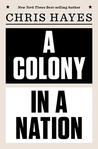
A Colony in a NationA Colony in a Nation by Christopher L. Hayes
My rating: 4 of 5 stars

Good stuff. But I have to admit is seems a little rambling at times. HOWEVER, I really like the paths he takes when he rambles. The ironic observations he tosses out are well received by me, but I do wonder if more academic types might quibble with some of the comparisons, especially the Rebellious American colonists apparently quite similar to the poor and oppressed of today (See below)

Hayes takes the title from a Nixon speech and he provides some context how that administration used the idea of white fear to play with political power. But the core idea of the book transcends historical timelines, especially given his philosophical closing argument.

But officially the idea is of viewing some people, usually poor and black as part of a separate Colony and this Colony is administered by the Nation (various local and nation forces) as a colonial occupation with military style actions. The resulting oppression is justified by need to keep Order for the nation, even at the expense of Justice (the Law) for the people in the colony.

He may be more organized than I see but is seems he offers a number of explanations at random as to what motivates this oppression.

Partial explanations-

Primarily it is white fear as the force that drives this oppression. The fear of loss or order in society. Basically taking outsized offence to anything to might disrupt the classic white suburban ultra-quiet neighborhood. He does offer examples of whites (with his own examples) committing non-violent crimes who are ignored or let off easy, against the shocking prison rate for blacks doing the same things

He makes some attempt to describe where this fear comes from but basically says it is obvious. And I guess it is.

Like a magnet tugging countless tiny filings into the bands of force around its poles, a profoundly political force was at work acting on the thousands of individual systems, actors and institutions, bringing them into tyrannical alignment.

That force was white fear
Pg. 115

The fear is mostly racially bound but it also breaks those boundaries to go beyond race. White fear can expand its horizons.

Part of the fear come from a Desire for Order over law (both items are actually perceptions rather than objective facts). So even if someone's rights are not considered it is OK. After all you don’t want to feel stressed out by people arguing outside your house.

American Culture its sense of Justice and Punishment

“…to say Black people wanted this too (more prisons and arrests) belies [the] fact that Blacks in the U.S. are AMERICANS. Americans LOVE punishment." Pg. 125

Related but somewhat sidebar observations

Irony of American Colonial reactions compared to the current oppressed Colony

John Hancock...was one of the most famous smugglers of his day. He was a criminal, basically-and he and his fellow smugglers kept the colonies running. Without the smuggled goods there would have been little local economy to speak of.
Pg. 52

“...the British crackdown (getting taxes) essentially inaugurated America’s first tough-on-crime era. It was a classic crackdown: more customs officials were granted more expansive powers. While courts were streamlined to produce swift punishment...(officials) began operating in ways that looked a lot like what we now call ‘stop and frisk’ ” Pg. 54

And the creepy way cities and towns across the country target the poor in order to fund the city (probably because it is apparently illogical to raise taxes anywhere)

[Ferguson – the colony] “...the purpose of policing and courts isn’t the maintenance of safety and provision of justice but rather some other aim. In north St. Louis County that aim is to produce revenue, the same aim of the British Empire’s customs regime in the American colonies.” Pg. 76

Guns and Iraq
[guns as protection against a tyrant] despite the fact that Iraq under Saddam Hussein had one of the highest rate of gun ownership in the world. Pg. 104

How language is used to confirm the threatening nature of The Colony

Racecraft: the Soul of Inequality in American Life, Karen and Barbara Fields trace the semantic trick of racial vocabulary, which invents categories for the purpose of oppression while appearing to describe things that already exist out in the world.

His and my conclusion

But in the end I think the most important point he makes is a Philosophical appeal to compassion. It is the not explicitly stated, but I think it is a central theme of his book and goes beyond this particular, but huge, injustice...How do we view our fellow humans?

Imagine a person commits a crime, perhaps even a violent crime, against you. Is that person even a human being? A neighbor, a fellow citizen? What do we as a society owe that person? Could he be someone you know and love in the throes of addiction? Or is he a member of a group you’ll never encounter again? What dignity is due the perpetrator? Do you and the perpetrator belong to the same country? This is the question before us. The question we’ve answered wrongly for too long. Pg. 210

You see the philosophy student peek through sometimes, his passionate outrage is obvious but like the quote above he also has the occasional dispassionate appeal to logic, which in this case it is used to encourage compassion, even for the criminal. But, I bet some people can't get past that. Once you commit a crime you are basically a damned soul.

One more thing, just to be clear. If you are a comfortable white guy, like me, you should be upset by the truth of this book

View all my reviews

1/11/2017

Accidents will happen...

I just wanted to save this quote from a book by Peter Bogdanovich, Who the Devil Made it:


7/31/2015

Brain Power

I started reading "Don't Even Think About It: Why Our Brains Are Wired to Ignore Climate Change " which lead me to "Emotional Brain" where a reviewer on amazon listed these as similar and good books

1. Descartes' Error: Emotion, Reason, and the Human Brain, by Antonio Damasio
2. The Language Instinct: How the Mind Creates Language, by Steven Pinker
3. Phantoms in the Brain: Probing the Mysteries of the Human Mind, by V. S. Ramachandran, Sandra Blakeslee
4. Nature's Mind: The Biological Roots of Thinking, Emotions, Sexuality, Language, and Intelligence, by Michael Gazzaniga
5. How Brains Think: Evolving Intelligences, Then & Now, by William H. Calvin

I just wanted to remember these titles

3/05/2015

Book Review to Keep This Blog Alive

The SamuraiThe Samurai by Shūsaku Endō
My rating: 4 of 5 stars

Aside from talking about cultural differences regarding how individuals relate to their community, there are many similar feelings expressed in this novel as in Deep River, but I like how following an (apparently) real historical story provided some boundaries for the theology.

I do think the crux of the book springs a theological consideration. Something like it is a big, big world and you cannot count on nations, tribes, churches or even the man next to you to not betray you. BUT for Endo there is always the emaciated, suffering Christ who hears your prayers, even if he cannot, or will not change your fate.

I found a snippet on the Internet where in an Interview Endo sympathizes with the Apostle Paul over the other Apostles.

Jews demand signs and Greeks look for wisdom, but we preach Christ crucified: a stumbling block to Jews and foolishness to Gentiles 1 Corinthians 1:22-25

And I that is a key point for the Samurai, he cannot grasp why people revere this loser. So after hearing the highlights of Jesus' life we read...

The samurai could not understand how a man like Velasco could believe a story so palpaly absurd. Pg 173

But by the end of the book he and his and his fellow envoy totally lost “Faith” in the local Lord their patron, the council of elders for which they previously would have given their life.

'The world was very wide. But I can no longer believe in people' that is what Nishi Kyusuke had said...pg 238

When questioning the renegade Japanese monk about his belief in Jesus...

“I can believe in Him now...because He was ugly and emaciated....He could not close His eyes to the grief and agony of mankind. That is what made him emaciated and ugly. Had he lived an exalted powerful life beyond our grasp, I would not feel like this about Him.” pg 220

Even if the Samurai never really accepted Christianity, by the end of his life, once everything had been stripped away from him and those in authority he once trusted betrayed him...he at least understood.

And there is also a less clearly stated notions of what living is really all about anyway. Except at the very end.

“Finally from within the white smoke which enveloped Velasco's stake, a single cry rang out.
'I...have lived...!'” pg 267

Of course Endo's view of Christianity is at odds which many churches of today, and actually even the Catholic Church of his own time. 

View all my reviews

10/17/2014

Posting Goodreads Just have some thing to put here

Collapse: How Societies Choose to Fail or SucceedCollapse: How Societies Choose to Fail or Succeed by Jared Diamond
My rating: 3 of 5 stars

I think Diamond gives a pretty even handed account of the way societies fail (and how a few succeed), and I don't think any world view he has skews his research. Although if you love the Montana wilderness and marvel at its beauty you almost inevitably come down on the side of environmentalists wanting to preserve that beauty. Is that a bias, or just a recognition of reality?

Anyway, a good book but maybe a bit too long. He tries to offer some cautious optimism at the end but for the most part it is an emotional beat down. The history of it all is very interesting, but usually it involves tales of how people are short sighted and just plain too arrogant to imagine things might go bad. And the modern tales of Rwanda with its Malthusian dilemma is horrible.

If you follow politics even only slightly you know big business and the republican party in particular, hate regulations and always feel individual rights (or more precisely, big corporation rights) have a higher value then environmental concerns. Yeah, yeah, I know, the Democratic party is not much better, but at least occasionally they sound less strident.

Anyway he says things like this...

“The challenge of deciding which of a society's deeply held core values are compatible with the society's survival and which ones instead have to be given up.” Pg 410

“the remaining solution to the tragedy of the commons is for the consumers to recognize their common interests and design, obey and enforce prudent harvesting quotas themselves”. Pg 429

I just don't see ANY nation, state or even a group of people of any size honestly looking at the way things are, and changing core values. It just ain't gonna happen. Maybe my pessimistic view skews my interpretation...but I doubt it.

The bad times may not come in my lifetime, but it seems they are going to come some time.

“So Long, and Thanks for All the Fish ”

View all my reviews

3/09/2014

A Rorschach Test Kind of Book

Deep RiverDeep River by Shūsaku Endō
My rating: 5 of 5 stars

Blessed are the meek, for they shall inherit the earth. Matthew 5:5

Jews demand signs and Greeks look for wisdom, but we preach Christ crucified: a stumbling block to Jews and foolishness to Gentiles 1 Corinthians 1:22-25

I wonder at the faith and Christianity of Shusaku Endo a thoughtful, reflectfull Japanese Christian. Did he feel as at odds with his faith and heritage as the central character, Otso, of Deep Rivet?Did he feel himself as outcast as Otsu who identified with the lowest caste of India?

I will draw a conclusion that Endo found the essence of Christ in the suffering sacrifice rather that the victorious resurrected champion of the prosperity gospel. I think Endo saw “true” Christianity in the comfort of the poor and meek.

I think more people would NOT like this book than do. In Endo's world the avenues of success only bring a hollow happiness. In my (American) world the general feel I get is that the Christianity brings a victorious uplifting life full of prosperity. Endo would have none of that. For him you only get to the truth by embracing the poor and outcast.

So....do you think this life is a project of empirical pluses and minuses and the point is to end up with a positive when you die? And the “authentic” life is one that discounts anything that is not measurable, and religion is at best an illusion and at worst the bane of humanity?

If so, this book will be nonsense to you.

Are your religions beliefs secure and do they provide reason and stability that explains everything? If so, this book will be nonsense to you.

There are a number of “themes” involving connecting with something. First, for Otsu, is the notion that Christ is found most clearly in the rejected. Which leads him, as a Catholic priest, to be shunned by his order and end up adopting the clothes of a Hindu untouchable who's only task is to carry other discarded, poor, and dying people to the river Ganges just before they die.

And then there is this idea that our existence is actually a river of humanity and we are all trying to connect with it. I think Endo is saying we use most of our energy avoiding the very things that really do give us the connection to everything else we need.

For Miss Naruse she wants to experience actual love, not the kind that is actually a role that people adopt with enthusiasm.

For Mr Kiguchi it is honoring his fellow Japanese soldiers who suffered a burtal retreat in WWII in Burma.

For Mr Numada it is a mystical connection with nature embodied by a Myna bird.

And finally for Mr Isobe, he is only recognizing his connection with his wife after she dies after telling him to look for her to be reborn somewhere in the world.

If I was to write a high school report about it I think I would come up with something about the Deep River of the the Ganges is much like life itself. And that the road of death Mr. Kiguchi was on is also much like life itself. In that we will all die sometime.

If you are sure of yourself, in your belief or non-belief...then you will think this book is nonsense. But for those of us you inexplicably think what the world tells us about itself is most likely wrong...well, you might end up loving this book.

Quotes...
After living nearly five years in a foreign country, I can't help but be struck by the clarity and logic of the way Europeans think, but it seems to me as an Asian that there's something they have lost sight of with their excessive clarity and their over abundance of logic, and I just can't go along with it....in the final analysis, the faith of the Europeans is conscious and rational, and these people reject anything they cannot slice into categories with their rationality. Pg117

But an Asian like me just can't make sharp distinctions and pass judgment on everything the way they do. Pg118

Every time I look at the River Ganges, I think of my Onion (Christ). The Ganges swallows up the ashes of every personas it flows along, rejecting neither the beggar woman who stretches out her finger-less hands for the murdered prime minister Gandhi. The river of love that is my Onion flows past, accepting all, rejecting neither the ugliest of men nor the filthiest. Pg 185

The Onion had died many long years ago, but he had been reborn in the lives of other people. Even after nearly two thousand years had passed, he had been reborn in those nuns, and had been reborn in Otsu. And just as Otsu had been taken off to a hospital on a litter, the nuns likewise disappeared in the river of people. Pg 215

View all my reviews

Think about it more, I guess it really isn't A Rorschach Test Kind of Book, but my thinking is aside from how objectively good or bad the book might be, it is the reader's world view that will determine what they think of it.

11/24/2013

My View of "The Room"

The Disaster Artist: My Life Inside The Room, the Greatest Bad Movie Ever MadeThe Disaster Artist: My Life Inside The Room, the Greatest Bad Movie Ever Made by Greg Sestero
My rating: 3 of 5 stars

Initially I felt the author either thought too much of himself or was too pretentious, but once you get into the story that falls away and it turns out to be pretty interesting.

Pretty interesting, but ultimately pretty depressing. Imagine Ed Wood with money but horribly handicapped by certainly u-examined insecurity.

But I think it is because Tommy has money you feel free to laugh at his mistakes as he tries to live his dream of being an amazing actor in the face of obvious inadequacies

Johnny’s declaration of “I cannot go on without you” was where the problems began. Tommy would move as far into the dialogue as “I cannot go on” and get confused and call out, “Line!”

Sandy would then dutifully feed him the rest: “Without you”
“I cannot go…Line!”
“On. Without you.”
"I cannot…Line!”
“Tommy, for God’s sake, ‘I cannot go on without you’”
“Okay. Thank you”
"Action!”
“I cannot go on…Line!”


View all my reviews

10/29/2013

Ad Man Murder Man

Murder Must Advertise  (Lord Peter Wimsey Mysteries, #10)Murder Must Advertise by Dorothy L. Sayers

My rating: 3 of 5 stars


Dorthy Sayers worked for an advertising company so surely the characters were accurate. And this is how she imagined the ideal aristocrat reacting...

The atmosphere suited him well enough. He was a bonhomous soul, with the insatiable curiosity of a baby elephant, and nothing pleased him better than to be interrupted in his encomiums of Sopo (“makes Monday, Fun-day”) or the Whoosh Vacuum-cleaner (“one Whoosh and it's clean”) by a fellow-member of the department, fed-up with advertising and spoiling for a chat.  (Kindle Locations 560-563)

And of course the '30 British language dazzles...

You see, Hankie-pankie told me to get out a list of names for a shilling tea and I got out some awful rotten ones, and then Ingleby came in and I said, 'What would you call this tea?' just like that, and he said, 'Call it Domestic Blend,' and I said, 'What-ho! that absolutely whangs the nail over the crumpet.' Because it struck me, really, as being the caterpillar's boots.” (Kindle Locations 644-647)

Every so often something not culturally sensitive sneaks in...

I need scarcely warn you against the golden-haired girl in distress, the slit-eyed Chink or the distinguished grey-haired man wearing the ribbon of some foreign order.” (Kindle Locations 4571-4572)

The needlessly long but enjoyable play by play of the cricket match was wonderfully interpreted for me by our resident Englishman at work. Thanks Tom!.

The innings opened briskly. Mr. Barrow, who was rather a showy bat, though temperamental, took the bowling at the factory end of the pitch and cheered the spirits of his side by producing a couple of twos in the first over. (Kindle Locations 4711-4712)

And finally one more listen to this wonderful world...

If you wants a murderer, Mr. Bredon's got 'is eye on one now, and you're jest playin' into the 'ands of the Black Spider and 'is gang–meaning to say, 'oever done this. Wot I meantersay, the time 'as come fer me ter divulge wot I know, and I ain't agoin'–cor lumme!” (Kindle Locations 5123-5125)


View all my reviews

9/24/2013

We Really Are Our Own Worse Enemy

Idiot America: How Stupidity Became a Virtue in the Land of the FreeIdiot America: How Stupidity Became a Virtue in the Land of the Free by Charles P. Pierce
My rating: 2 of 5 stars

Pierce says he appreciates that America is a place where every crank can show whatever wild theory and God bless him if he finds a following. The problem is it seems the cranks are running the country and not out on the street corner.

The way this happens is the 3 Great Premises of Idiot America that the masses seem to eat up

1: Any theory is valid if it sells books, soaks up ratings, or otherwise moves units.

2: Anything can be true if someone says it loudly enough.

3: Fact is that which enough people believe. Truth is determined by how fervently they believe it.

This would be fine for the marketplace of ideas if there was a balanced, intelligent body around to challenge the wild eyed ones when the approached governing America. That way any actual ingenious idea would get through. BUT, in today's politics the elected representatives ARE the cranks and any expert with well researched thought out data is left in the dust because the there premises trump balanced reasoning.

The main examples are Biblical Creationism creeping into school science class cloaked as Intelligent Design, Denying Global Warming, and The Terri Shiavo showboating Republicans forced on America.

I say forced, but the thing is all these people are elected idiots (I'm a “life is complicated and there are many sides to each story” kind of guy, BUT anybody who falls on the non-science side of the above issues is an Idiot. Maybe they are wonderful people at home, but on these counts...). As I was saying, for the most part he blames the politicians but WE the PEOPLE elected these bozos so POGO's quote was especially prescient "We have met the enemy... and he is us" . OR maybe people in general have always been idiots.


Titbits

I didn't realize that it was under Reagan that dropping regulations in radio basically setup the nation of the saturation of conservative talk radio. There used to be this thing call the fairness doctrine where any view on radio or TV required the station to offer opposing views. What a quaint idea. Being fair about the issues. That would never fly now.

In 2003, the psychologist Paul Ginnetty examined this dynamic in Newsday, focusing on Limbaugh’s show but analyzing the appeal of the entire genre, what he called “the potent narcotic of reassuring simplicity.” (pp. 109).

He goes on how today politics requires not determining the best ideas but rather the best narrative.

The apotheosis of the modern novelized presidency was that of Ronald Reagan.
(p. 234).

He offers up James Madison as the intelligent founding father we really should be emulating. But from the little reading I've done of that era, for all the wisdom of those chaps, it really could have gone off in another direction since I wonder, but don't know, if there were probably a fair share of cranks in the continental congress at the time.

In conclusion:
We've chosen up sides on everything, fashioning our public lives as though we were making up a fantasy baseball team. First
(p. 261)

After pulling together notes for this review I a bit depressed, and I promised myself to cut back on the Vino so it will be a tough night.

View all my reviews

9/17/2013

A Cockeyed World

Winter in the BloodWinter in the Blood by James Welch
My rating: 4 of 5 stars

James Welch was first published as a poet and I think this prose shows his poetic beginnings

My lure caught a windfall trunk and the brittle nylon snapped. A magpie squawked from deep in the woods on the other side of the river. Pg6

But over all Winter in Blood is a hard book. Severe.

“And I was staring at the sobbing woman with the same lack of emotion, the same curiosity, as though I were watching a bug floating motionless down an irrigation ditch, not yet dead, but having decided upon death.
I slid off her. Everything had gone out of me, and I felt the kind of peace that comes over one when he is alone, when he no longer cares for warmth, and or sunshine, or possesions or even a woman's body, so yielding and powerful.” pg 99


I had a bias going into this story. I think that I thought a book by a Native American writer (I read he didn't care for the term but it is what is said now) would somewhere have an answer for me to the conflicts I see in our modern world.

Am I falling into a vague stereotype about Native America wisdom? Like I might then go on a sweat lodge retreat and contact a sympathetic animal spirit?

Winter in Blood is more a modern novel about a universal sense of separation and alienation written by a native American than primarily a native American novel, ok, maybe, maybe not.

BUT there was some indication of an underlying reply to the western civilization we know. He at least acknowledges what I have felt for a while, that there is something messed up in the world. The clearest statement is when the old, blind yellow Calf about talks with animals and why they are unhappy.

“They are not happy with the way things are. They know what a bad time it is. They can tell by the moon that the world is cockeyed.”

So maybe it does cover some of the territory of Ceremony by Silko, but Ceremony was much more explicit.


View all my reviews

9/10/2013

Just Kill Me Now. We are all Doomed

Tear Down This Myth: How the Reagan Legacy Has Distorted Our Politics and Haunts Our FutureTear Down This Myth: How the Reagan Legacy Has Distorted Our Politics and Haunts Our Future by Will Bunch
My rating: 3 of 5 stars

The book starts with a description of the Cult of personality as applied to Reagan
step 1: Eliminate any negative reference, such as Iran Contra
step 2: Award credit where it is not due: Cold War was Reagan ignoring 40 years
step 3: Whitewashing any qualities that don't mesh with the new vision. Good Qualities as well as bad, such as the fact that he talked with the enemy and compromised and raised taxes

I was frankly amazed that there was so much good to say about the man, of course it was mainly because he didn't follow through on his rhetoric.

For all his hawkish bluster the only real military engagement was Grenada (don't get me started on that pile of ..well pile something). AND it turns out his advisers multiple times tried to get him to invade Panama, but he always refused.

And of course for all the praise the massive 1981 tax cuts Tea-baggers praise, it turns out he raised taxes for the next six years. Something like 11 times.

But good points and nuance aside, one of the more frustrating things was the replay of the Carter Reagan debate where at one point Carter said..

Now we have and opportunity to move forward toward national health insurance, with an emphasis on the prevention of disease and...(he goes on make wonderfully important and telling points)

Reagan's response...

There you go again.

A line Reagan had practiced over and over again and he killed with it.

The fact that this line is remembered with affection and some odd example of how wonderful Reagan was, makes me think our country really is doomed.

But the thing that sticks in my mind the most was Reagan's misquote where he said

Facts are stupid things

He meant to say facts are stubborn things, but really he was unwittingly insightful. Facts by themselves mean nothing, they require context and interpretation.

One could say it is a fact that Carter had the solution to our current energy problems decades ago, or that he was the one that started the deregulation of big business, or that he was already rebuilding the military or appointed Paul Volker who was truly responsible for reigning in inflation. You could say that but every one of these facts say one thing to me, but to conservatives they prove the opposite.

It is like how I imagine a tarot reading (I really don't know), you lay down one card (a fact) but all the other you place around it influence the reading until the next thing you know the seer-er is telling you that Reagan shrank the size of government and the deficit.

The author does a pretty good job of tracing the beatification of St Reagan and points out that by the end of his presidency he was only mildly popular and one of those irritating rate the President polls one time had him, Carter and Clinton about the same (before Clinton's blue dress problems)

By the time of his death it was as if George Washington had come back to life and died just to get some press coverage. Almost no mention of Iran Contra, which another of the facts don't matter that he was advised selling arms to Iran was an impeachable offense and he said not to worry about it.

He also points out that the ramping up of the Reagan sainthood got underway around the time the demonize Clinton industry took off. His point was that in order to have a hero you have to have a villain. Maybe there is some of that in the Obama hater's club.

The latter part of the book looses focus for me since he leaves the hypothetical world of facts and starts opining on what it all means and what America is really like. All very vague and hard to prove. But then again that is the gist of the Reagan lesson, Proof is now really just strongly stated belief. Do it just like Reagan did, and you may recall George Costanza in Seinfeld clarified it when he said “It's not a lie if you believe it!” Reagan believed it.

View all my reviews

8/28/2013

Believe It Or Not!

The Religious Case Against BeliefThe Religious Case Against Belief by James P. Carse
My rating: 3 of 5 stars

Book in one sentence ...

Belief is the antitheses of Religion which is closer to poetry and people conflate knowledge with belief to the detriment of all mankind.

Here he means Belief to be "Belief Systems" and religion is defined by him as an open inquiring look at existence, much like poetry. And Religion is a process of learning ignorance that prompts us to strive ever harder toward higher aspiration. Or something like that.

For me the most intriguing part is his example of Galileo before the pope when he is asked to deny the truth of his scientific conclusions.

“When the pope assumed that belief (for him knowledge) represented the end of ignorance, Galileo saw it as the beginning of ignorance, Galileo was not a convert. The truth was not revealed to him. He came to it after a lifetime of study. He knew, as any critical thinker would, that knowledge is corrigible, and that belief is rarely so. Open to correction himself, he had not inclination and no reason to take an immovable stand. He could not perform an heroic act like Luther’s not because of cowardice but because there was nothing to stand on. Belief systems are already complete. No new knowledge can reverse their finality. Knowledge, in other words, is never knowledge against….” Pg 60

I feel this touches on so much, so much that is tantalizing and appealing for me. But it somehow misses the mark. The books comes close to showing how "higher ignorance" actually fuels knowledge AND religion but never quite gets there.

In my hackneyed and often inebriated explanation of Religion I have tried to use the poetry analogy but it never really makes an impression. People who "believe" don't need it and unbelievers don't care.

All in all I think he highlights and important and true but hard to pin down intersection of belief and knowledge AND how faith and ignorance are tied to them.

The problem is that, I think, that for the majority of people Religion IS a belief system, and various religions are simply an accumulation of enumerated beliefs. This is so for non-believers as well as "believers".

Looking at the way conservative Christians view the world it is easy to see the confusing of Belief with Knowledge. But then again, the non believer's view of the world can be just as rigid as the fundamentalist. They both thrive on anger and disdain of the other view.

I once watched "Flock of Dodos:" on Netflix and the amazing thing was the scientists were just as angry and dismissive of the fundamentalist as the Creationists were of the scientists. The manner and rhetoric was the same. Don't be confused, teaching science via the Bible is crazy, but still...maybe what bothered me was the fundamentalist were trying to use their religion as a belief system to explain science and the scientists acted like the creationists where attacking their religion, an everybody reacted emotionally. To be sure the fundamentalists ignored obvious evidence ("willful ignorance") but in one scene the anthropologists were almost apoplectic in their denunciation of their opposites and would never accept there might be a spiritual motivation for the other side. So the question is, should scientists even try to understand with compassion this alien point of view?

Perhaps related, decades ago I read a book that pointed out fundamentalists want to take the spiritual and turn it into the material in a perverse and flawed mimicry of science. That way you can prove that which truthfully can never be "proved".

The author struggles to define Religion, sometimes as poetry, comomunitas, longevity of existence, and more. But really I find the Dali Lama's definition more convincing, where religion as that which engenders "compassion". Simple and inspiring. (I have no attribution for this but I heard it somewhere). But compassion is something missing from this book and may explain why I find it lacking.

In fact there seems to be a gaping hole in this book; for me there is never a real feel of why people are religious at all. He mentions Jesus and Islam and Buddhism throughout, but never really indicates why one should bother. He is pretty good pointing out that the Religion as belief system is rigid and really the heart of all the bad press in any religion. But aside from this yearning for Religion as a poetic expression of a spiritual truth (although I don't think he ever used the word spiritual, which is odd to me)he is pretty unconvincing on why people should go down that road at all.


All in all the audience for this books strikes me as limited since if you think Religion is all bollocks anyway you see no point to entertaining these ideas. And those who are into some sort of religion seem to be pretty well set, why bother thinking about it any more.

Here are some quotes I like...
“Belief systems are stunningly resistant to such correction, for the simple reason that deeply held committed believers are not offering a variety of debatable proposals about the nature of the world. They see the world through their beliefs, not their beliefs from a worldly perspective” pg 28

“…belief marks the line at which our thinking stops…” pg 44

"Believers and warriors tend to merge into one another: the military sees itself in religious terms, while believers take one the images of warfare." Pg 77

"Religion in its purest form is a vast work of poetry." Pg 111

"Belief systems offer a rational and consistent view of everything...” pg 145


sacred texts...”They must be interpreted. That is they do not come to life until there is a living response to them.” pg 189


View all my reviews

8/14/2013

A Shocking Development

The Shock Doctrine: The Rise of Disaster CapitalismThe Shock Doctrine: The Rise of Disaster Capitalism by Naomi Klein
My rating: 4 of 5 stars

The short version is...it is all hopeless and corporations are set to take as much public money as possible, and good governance is demeaned to the point that public works becomes an evil idea.

As far as the book itself and how the title fits in, I can see part of her argument as analysis with metaphor, where the Psychological treatment of shock therapy (of the worst type) corresponds to Milton Friedman's idea that his free market policies are best implemented quickly to shock the economy out of its old bad ways.

FYI The history of the shock treatment that was later taken up by the CIA sanctioned torture guides was pretty gruesome to read about.

The other metaphor used is a cancer metaphor where to get an economy to a free market state you have to cut out all the bad parts of the economy taking perhaps colateral flesh along the way as a means to stop the disease.

While reading Shock Doctrine I checked some reviews and critiques of it...I don't know what I expected but BOY some people really, really hate her. I mean despise and insult in the crudest fashion.

For all the railing by free market fans against her for talking ill of Friedman, it is completely true that his only interest in people was the capitalist world he thought we should be living in. If people suffer and die it is not on his radar. He simply advises or admires anybody who implements his ideas, he is just the technician. Kind of like Werner Von Braun shooting bombs in the air but where they come down was somebody else's department. Freidman and his followers are shocked and incredulous that anybody sees any connection between a regime embracing the Chicago School and using brutal means to prevent any dissent from that view. For me, if I was a famous economist and you used my theories as an excuse to murder and torture...THAT'S a DEAL-BREAKER!!


The Chicago Boys had confidently assured Pinochet that if he suddenly withdrew government involvement from these areas all at once, the “natural” laws of economics would rediscover their equilibrium, and inflation— which they viewed as a kind of economic fever indicating the presence of unhealthy organisms in the market— would magically go down. They were mistaken. pg 97


Even if you accept Klein has her own biases, I think this does confirm the religious nature of neo conservative and the current Ayn Rand enthusiasts. It is a article of faith that lower or no taxes, less or no public services will result in a blossoming of economic success and happiness

“What was particularly exciting were the same qualities that made Marxism so appealing to many other young people at the time,” recalled the economist Don Patinkin, who studied at Chicago in the forties—“ simplicity together with apparent logical completeness; idealism combined with radicalism.” 10 The Marxists had their workers’ utopia, and the Chicagoans had their entrepreneurs’ utopia, both claiming that if they got their way, perfection and balance would follow." pg 63
.

Bruno conceded that deepening or creating a serious economic meltdown was frightening— government salaries would go unpaid, public infrastructure would rot— but, Chicago disciple that he was, he urged his audience to embrace this destruction as the first stage of creation. “Indeed, as the crisis deepens the government may gradually wither away,” pg 328


.

The book goes on and on with one depressing story after another, but it boils down to the fact that big corporations will do anything to make money. And when you couple that with a political movement that thinks government can't be part of any solution and private business is always better than public servants...then a cycle is started where poorly implemented governing produces poor results which makes things worse, which reinforces the original premise which means more privatization is required.

It seems so inevitable one just gives up and retreats to the bed room and watches endless episodes of 30 Rock on Netflix.

View all my reviews