2/10/2017

An Aikdo School Droput Says More Than He Should...

1. There is this...

The koppo side of Aikido studies destruction, and knowledge of how to destroy an attacker in order to save your life and the lives of others.  

My purpose is to guide Aikido students away from the “dancing mindset’, from training in a comfortable way mentally and physically.  I want to make them think about the real meaning, the real application of “harmony” – it comes from the moment of being in front of an enemy who can destroy you, who is not going to participate in your harmony. This is the essence of O Sensei’s Aikido meaning, and without this understanding Aikido is missing something important.  I often ask my students, “can you defend your life?” Because if your answer is “no”, then your Aikido has no real meaning and you have no real understanding of Aikido principle.  If Aikido is just dancing for you, then your Aikido is shallow, and it has no ability to either defend or heal.


Yeah, I get it...if you don‘t want to kill someone you are a woosey, a pansy, a wimp… a LOSER! If you come away from the practice with a sense of harmony and that the uke is not really the enemy and that Aikdio is the art of peace, then you are an idiot.Plus he was the coolest uchideshi of all and the others were pretty lame.

Ultimately that is what it means. Nothing matters unless you can kill somebody. THAT is what koppo really means. 

 Of course since I never advanced to level of being able to survive a cage match I never really had an understanding of Aikdo, so you can safely ignore me. Of course a boat load of other practitioners are no better off, so why even try? Just give it up and buy a gun, THEN you can defend your self and it take no practice at all.

How can I say this since I am not an Aikido master? Screw that, I am an Aikido school drop out, an Aikido loser. BUT I am also a human, and I realize that for a lot of people martial arts is about being a badass. And I know people and what they want, and they want to WIN and even more so make the other guy LOSE. And what could prove it more than if you can destroy the other guy.

If you check out Aikdo on the Internet there are tons of Aikido guys who have chip on their shoulder when Karate or MMA people say Aikido is crap. Basically they want to prove their “kung fu” is way better than the other guy’s. Some macho Aikido people want to be considered bad ass, And by bad ass I meant destructive, hurtful and able to kill.

And the real take away from the article is unless you want to destroy (kill) the other guy you are not practicing real Aikido. Plus I am sure the the thing about it NOT BEING DANCING is a denigration for another O’ Sensei uchideshi (Just like Saotome) Terry Dobson who wrote a book about Aikido called It’s A Lot Like Dancing  

Dobson was a fascinating guy, we was a typical aggressive American who ended up in post war Japan and studied closely with O’ Sensei. His most famous Aikido Story is here 

And the point being, the art of harmony starts with seeing that your attacker is not your enemy. And using Aikido to deal with conflict comes NOT from a desire to destroy but from a desire to love.

Consider O’ Sensei’s enlightment story…

O-Sensei’s Enlightenment
(The following is taken from John Steven’s Abundant Peace and Kisshomaru Ueshiba’s Aikido):

In the spring of 1925, 42-year old Morihei was transformed by a divine vision. One day, a naval officer visiting Ayabe decided to challenge Morihei to a kendo match.  Morihei consented but remained unarmed.  The officer, a high-ranking swordsman, was naturally offended at this affront to his ability and lashed out at Morihei furiously. Morihei easily escaped the officer’s repeated blows and thrusts.  When the exhausted officer finally conceded defeat, he asked Morihei his secret.
Just prior to your attacks, a beam of light flashed before my eyes, revealing the intended direction.” 
 
Following the contest, Morihei went out to his garden to draw water from the well and to wash the sweat from his face and hands.  This is what he later said about what happened:
I set my mind on budo when I was about 15 and visited teachers of swordsmanship and jujutsu in various provinces.  I mastered the secrets of the old traditions, each within a few months.  But there was no one to instruct me in the essence of budo: the only that that could satisfy my mind.  So I knocked on the gates of various religions but I couldn’t get any concrete answers. 
 
Then in the spring of 1925, when I was taking a walk in the garden by myself, I felt that the universe suddenly quaked, and that a golden spirit sprang up from the ground, veiled my body and changed my body into a golden one.  At the same time my mind and body became light.  I was able to understand the whispering of the birds and was clearly aware of the mind of God, the Creator of this universe. At that moment I was enlightened: the source of budo is God’s love – the spirit of loving protection for all beings.  

Endless tears of joy streamed down my cheeks.  …  I understood, ‘Budo is not felling the opponent by our force; nor is it a tool to lead the world into destructions with arms.  True budo is to accept the spirit of the universe, keep the peace of the world, correctly produce, protect and cultivate all beings in Nature.  The training of budo is to take God’s love, which correctly produces, protects and cultivates all things in Nature, and assimilate and utilize it in our own mind and body.’” 


So is Aikdio like this... “True budo is to accept the spirit of the universe, keep the peace of the world, correctly produce, protect and cultivate all beings in Nature.” or is it to destroy the opponent? Like I said, I am an Aikdo School dropout, and absolutely no authority in the matter, except maybe the authority of reading about O’ Sensei. And it is painful to admit, but when I was practicing I was never very good at it, but I still think about it every day. While I am sure O’ Sensei was a crazy,, complicated, confusing old school master...I see the wisdom of dealing with conflict, not by “destroying” but by seeking redirection and harmony.

1/16/2017

doomed colleagues in the American media


I've never heard of this guy but I wanted to remember this post...


https://medium.com/@alexey__kovalev/message-to-american-media-from-russia-6e2e76eeae77#.elhencmqd

 --------------

A message to my doomed colleagues in the American media

Congratulations, US media! You’ve just covered your first press conference of an authoritarian leader with a massive ego and a deep disdain for your trade and everything you hold dear. We in Russia have been doing it for 12 years now — with a short hiatus when our leader wasn’t technically our leader — so quite a few things during Donald Trump’s press conference rang my bells. Not just mine, in fact — read this excellent round-up in The Moscow Times.


Vladimir Putin’s annual pressers are supposed to be the media event of the year. They are normally held in late December, around Western Christmas time (we Orthodox Christians celebrate Christmas two weeks later and it’s not a big deal, unlike New Year’s Eve). Which probably explains why Putin’s pressers don’t get much coverage outside of Russia, except in a relatively narrow niche of Russia-watchers. Putin’s pressers are televised live across all Russian TV channels, attended by all kinds of media — federal news agencies, small local publications and foreign reporters based in Moscow — and are supposed to overshadow every other event in Russia or abroad.

These things are carefully choreographed, typically last no less than four hours, and Putin always comes off as an omniscient and benevolent leader tending to a flock of unruly but adoring children. Given that Putin is probably a role model for Trump, it’s no surprise that he’s apparently taking a page from Putin’s playbook. I have some observations to share with my American colleagues. You’re in this for at least another four years, and you’ll be dealing with things Russian journalists have endured for almost two decades now. I’m talking about Putin here, but see if you can apply any of the below to your own leader.
  • Welcome to the era of bullshit.
Facts don’t matter. You can’t hurt this man with facts or reason. He’ll always outmaneuver you. He’ll always wriggle out of whatever carefully crafted verbal trap you lay for him. Whatever he says, you won’t be able to challenge him. He always comes with a bag of meaningless factoids (Putin likes to drown questions he doesn’t like in dull, unverifiable stats, figures and percentages), platitudes, false moral equivalences and straight, undiluted bullshit. He knows it’s a one-way communication, not an interview. You can’t follow up on your questions or challenge him. So he can throw whatever he wants at you in response, and you’ll just have to swallow it.


Some journalists will try to preempt this by asking two questions at once, against the protests of their colleagues also vying for attention, but that also won’t work: he’ll answer the one he thinks is easier, and ignore the other. Others will use this opportunity to go on a long, rambling statement vaguely disguised as a question, but that’s also bad tactics. Non-questions invite non-answers. He’ll mock you for your nervous stuttering and if you’re raising a serious issue, respond with a vague, non-committal statement (“Mr President, what about these horrible human rights abuses in our country?” “Thank you, Miss. This is indeed a very serious issue. Everybody must respect the law. And by the way, don’t human rights abuses happen in other countries as well? Next question please”).
But your colleagues are there to help you, right? After all, you’re all in this together?
Wrong.

  • Don’t expect any camaraderie
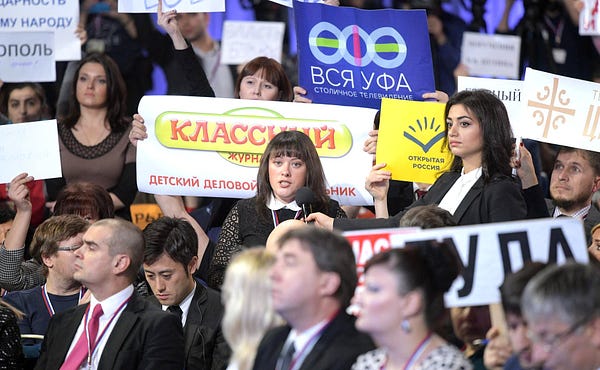
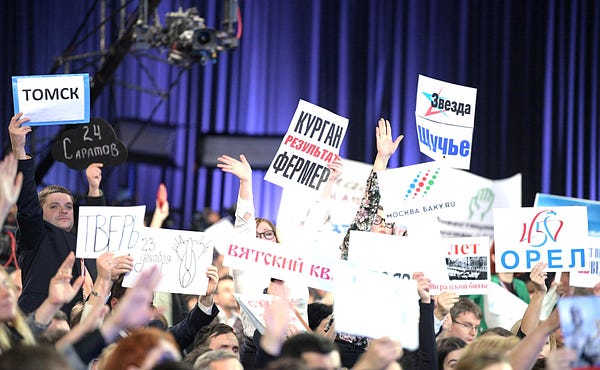
These people are not your partners or brothers in arms. They are your rivals in a fiercely competitive, crashing market and right now the only currency in this market is whatever that man on the stage says. Whoever is lucky to ask a question and be the first to transmit the answer to the outside world wins. Don’t expect any solidarity or support from them. If your question is stonewalled/mocked down/ignored, don’t expect a rival publication to pick up the banner and follow up on your behalf. It’s in this man’s best interests to pit you against each other, fighting over artificial scarcities like room space, mic time or, of course, his attention. It’s getting especially absurd because some — increasingly many — reporters will now come with large, bright placards aimed at attracting the president’s attention to names of their regions or specific issues. This is what it looks like:


Also, some people in the room aren’t really there to ask questions.
  • Expect a lot of sycophancy and soft balls from your “colleagues”
A mainstay of Putin’s press conferences is, of course, softball questions. Which also happen to be Putin’s favorites. Mr President, is there love in your heart? Who you will be celebrating New Year’s Eve with? What’s your favorite food? “Questions” of this sort, sure to melt Putin’s heart, typically come from women working for small regional publications. A subtype of this is also statements-as-questions, but from people who really love the man on the stage and will bob their head and look at the stage adoringly and say something to the tune of “Mr President, do you agree that a lot of media are treating you unfairly?”

Another type of softball questions is hyperlocal issues that a president isn’t even supposed to be dealing with. Mr President, our road is full of potholes and local authorities aren’t doing anything about it. Mr President, our tap is leaking. Mr President, how about a chess club in our village. This is a real opportunity for him to shine. He will scold the local authorities and order to have a new road built. All of this, of course, has been choreographed well in advance.

Also, some of these people really love him and will meet his every answer with enthusiastic applause. There will be people from publications that exist for no other reason than heaping fawning praise on him and attacking his enemies. But there will also be one token critic who will be allowed to ask a “sharp” question, only to be drowned in a copious amount of bullshit, and the man on the stage will always be the winner (“See? I respect the media and free speech”).
  • You’re always losing
This man owns you. He understands perfectly well that he is the news. You can’t ignore him. You’re always playing by his rules — which he can change at any time without any notice. You can’t — in Putin’s case — campaign to vote him out of office. Your readership is dwindling because ad budgets are shrinking — while his ratings are soaring, and if you want to keep your publication afloat, you’ll have to report on everything that man says as soon as he says it, without any analysis or fact-checking, because 1) his fans will not care if he lies to their faces; 2) while you’re busy picking his lies apart, he’ll spit out another mountain of bullshit and you’ll be buried under it.
I could go on and on, but I think at this point you see where this is heading. See if any of this rings any bells if you covered Trump’s presser or watched it online.

P.S. You’re welcome to repost/reblog/republish this if you like.

My name is Alexey Kovalev, I’m a Russian journalist and I’m writing about propaganda, fake news and Russian state media on noodleremover.news. It’s all in Russian, but here’s an example of what I’m doing in English. You can contact me at kovalever@gmail.com. I tweet as @Alexey__Kovalev.


1/11/2017

Accidents will happen...

I just wanted to save this quote from a book by Peter Bogdanovich, Who the Devil Made it:


12/20/2016

Truth and Power

The point of modern propaganda isn’t only to misinform or push an agenda. It is to exhaust your critical thinking, to annihilate truth.
Garry Kasparov, Russian dissident and former world chess champion


The ideal subject of totalitarian rule is not the convinced Nazi or the convinced Communist, but people for whom the distinction between fact and fiction (i.e., the reality of experience) and the distinction between true and false (i.e., the standards of thought) no longer exist.


12/19/2016

Thining About Thinking, Thinking About Living

I want to bookmark this review of Daniel Kahneman's book Thinking, Fast and Slow.

http://www.nybooks.com/articles/2011/12/22/how-dispel-your-illusions/

this comes form reading Michael Lewis' book The Undoing Project and then looking online for reviews.


It is understandable that Kahneman has no use for Freud, but it is still regrettable. The insights of Kahneman and Freud are complementary rather than contradictory. Anyone who strives for a complete understanding of human nature has much to learn from both of them. The scope of Kahneman’s psychology is necessarily limited by his method. His method is to study mental processes that can be observed and measured under rigorously controlled experimental conditions. Following this method, he revolutionized psychology. He discovered mental processes that can be described precisely and demonstrated reliably. He discarded the poetic fantasies of Freud.

But together with the poetic fantasies, he discarded much else that was valuable. Since strong emotions and obsessions cannot be experimentally controlled, Kahneman’s method did not allow him to study them. The part of the human personality that Kahneman’s method can handle is the nonviolent part, concerned with everyday decisions, artificial parlor games, and gambling for small stakes. The violent and passionate manifestations of human nature, concerned with matters of life and death and love and hate and pain and sex, cannot be experimentally controlled and are beyond Kahneman’s reach. Violence and passion are the territory of Freud. Freud can penetrate deeper than Kahneman because literature digs deeper than science into human nature and human destiny.

11/28/2016

Behavioral Economics Exmple #1

I happened across this when Goggling Behavioral Economics, and I didn't want to forget it.

Another example of how easy it is to be unaware of being manipulated


 What are some examples of the real-world use of behavioral economics?

One of the primary questions in this particular study was how do purchase quantity limits (ex. Limit of 12) influence consumer behavior? Cans of soup were marked down from $.89 to $.79, and three grocery stores offered a different purchase quantity limit:

1. No Limit
2. Limit of 4
3. Limit of 12

The study shows that the purchase quantity limit affected the number of soup cans the customer purchased.
  1. Customers that saw "No Limit" on average purchased 3.3 cans
  2. Customers that saw "Limit of 4" on average purchasedand 3.5 cans.
  3. Customers that saw "Limit of 12" on average purchased 7.0 cans.
https://www.quora.com/What-are-some-examples-of-the-real-world-use-of-behavioral-economics

Kafka; The Brother I Never Knew

Strangely I have never been able to get "into" Kafka. But this quote attracts me in an uncomfortable way.
Thanks to J Store for having such cool stuff like Franz Kafka and Animals by Peter Stine

http://www.jstor.org/