8/14/2013

A Shocking Development

The Shock Doctrine: The Rise of Disaster CapitalismThe Shock Doctrine: The Rise of Disaster Capitalism by Naomi Klein
My rating: 4 of 5 stars

The short version is...it is all hopeless and corporations are set to take as much public money as possible, and good governance is demeaned to the point that public works becomes an evil idea.

As far as the book itself and how the title fits in, I can see part of her argument as analysis with metaphor, where the Psychological treatment of shock therapy (of the worst type) corresponds to Milton Friedman's idea that his free market policies are best implemented quickly to shock the economy out of its old bad ways.

FYI The history of the shock treatment that was later taken up by the CIA sanctioned torture guides was pretty gruesome to read about.

The other metaphor used is a cancer metaphor where to get an economy to a free market state you have to cut out all the bad parts of the economy taking perhaps colateral flesh along the way as a means to stop the disease.

While reading Shock Doctrine I checked some reviews and critiques of it...I don't know what I expected but BOY some people really, really hate her. I mean despise and insult in the crudest fashion.

For all the railing by free market fans against her for talking ill of Friedman, it is completely true that his only interest in people was the capitalist world he thought we should be living in. If people suffer and die it is not on his radar. He simply advises or admires anybody who implements his ideas, he is just the technician. Kind of like Werner Von Braun shooting bombs in the air but where they come down was somebody else's department. Freidman and his followers are shocked and incredulous that anybody sees any connection between a regime embracing the Chicago School and using brutal means to prevent any dissent from that view. For me, if I was a famous economist and you used my theories as an excuse to murder and torture...THAT'S a DEAL-BREAKER!!


The Chicago Boys had confidently assured Pinochet that if he suddenly withdrew government involvement from these areas all at once, the “natural” laws of economics would rediscover their equilibrium, and inflation— which they viewed as a kind of economic fever indicating the presence of unhealthy organisms in the market— would magically go down. They were mistaken. pg 97


Even if you accept Klein has her own biases, I think this does confirm the religious nature of neo conservative and the current Ayn Rand enthusiasts. It is a article of faith that lower or no taxes, less or no public services will result in a blossoming of economic success and happiness

“What was particularly exciting were the same qualities that made Marxism so appealing to many other young people at the time,” recalled the economist Don Patinkin, who studied at Chicago in the forties—“ simplicity together with apparent logical completeness; idealism combined with radicalism.” 10 The Marxists had their workers’ utopia, and the Chicagoans had their entrepreneurs’ utopia, both claiming that if they got their way, perfection and balance would follow." pg 63
.

Bruno conceded that deepening or creating a serious economic meltdown was frightening— government salaries would go unpaid, public infrastructure would rot— but, Chicago disciple that he was, he urged his audience to embrace this destruction as the first stage of creation. “Indeed, as the crisis deepens the government may gradually wither away,” pg 328


.

The book goes on and on with one depressing story after another, but it boils down to the fact that big corporations will do anything to make money. And when you couple that with a political movement that thinks government can't be part of any solution and private business is always better than public servants...then a cycle is started where poorly implemented governing produces poor results which makes things worse, which reinforces the original premise which means more privatization is required.

It seems so inevitable one just gives up and retreats to the bed room and watches endless episodes of 30 Rock on Netflix.

View all my reviews

7/13/2013

Reflections of Wabi-sabi (侘寂)*

Well, that only lasted a week (See previous posting).

But the upside is instead of lethargy, indulgence and general apathy, I only suffer from excessive laziness.

The photo is from a Kodak Brownie Bull's-Eye Camera dated from the mid 1950's it seems sunlight manages to seep in from some undetermined part in the camera. I should have known the missing screws on the front faceplate might cause a problem.

But I embrace this world of non-perfection even as I try to seek out the best, the most beautiful (or ugly) or just interesting photo, book, adventure...So that said, here is me reflected in the window while taking a picture of a cat. Notice the light leaks at top and the odd bowed nature of the window frame. I don't know if that is the cameras or the way I scanned the negative. But in this case I think the imperfections make it a much more interesting image.

If I were a film maker I would end up in the Ed Wood camp rather than the Martin Scorsese club. But honestly I am OK with that, just as long as I don't end up in the Stephen Spielberg zone.


*Wabi-sabi (侘寂) represents a comprehensive Japanese world view or aesthetic centered on the acceptance of transience and imperfection. I think I have used this point before, but it seems even more relevant now.


More pics

6/30/2013

A New, Newer, Newest Beginning


I hear-by declare a new, newer, newest beginning. I will reverse this trend of lethargy, indulgence and general apathy. Yes the world is doomed. I am sure it will end badly. But hey, what are you going to do.

The first noble truth of the Buddha is that existence is suffering, a sort of Asian version of original sin. And I kind of agree with both east and west versions.

But an answer by way of an analogy may be the advice for practitioners of Zen meditation. You are told that while sitting there following your breath, or breathing a phrase, mantra or simply “just sitting”, if a thought arises, don't worry that your mind wondered into concepts. Just note it and go back to your breath. Neither seek these diversions out, nor chase after them, just breathe.

So too, as we see ample examples of the ineluctable flawed nature of the world, neither freak out at its obviousness and focus on it, nor be pulled into intelectual despair. Return to the breathe. Return to the now.

My hope is that by trying to pursue a sort of walking, driving, eating, meditation, this mindfulness will result in less food, drink and laziness. Well that is the plan.

I started this newest way by riding around the lake this morning and taking some pictures with a possibly flawed old camera. Basically I will take whatever flawed tools I have (physical or psychological) and just do what I can at the moment.

I didn't note the anniversary of this blog at the beginning of the month, so I guess this is a belated recognition. 6 years older and maybe none the wiser, but as with the coming apocalypse, hey what are you gonna do?

4/29/2013

From the Foundation

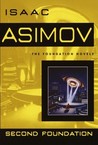
Second Foundation (Foundation, #3)Second Foundation by Isaac Asimov
My rating: 3 of 5 stars

I decided to read the original three foundation books by isaac asimov just because I read a comment on a blog. The blog post had something about big data analytics, which I gather is some new fangled statistics thing. Anyway a commenter said big data was like Harry Sheldon's law of mob psychology.

This will make the third time I've read these three books. The first time was maybe 35 years ago and the second 15 years back. I remembered only the sketchiest outline of the store, but I more or less had some of the big points.

I think it holds up pretty well as a sci fic classic, and I thought the episodic structure was very engaging. Even if it started out that way because the first book was really just a collection of previously published short stories.

I like a good sci fic tale, but the problem is when I look at most books, it seems that “speculative fiction” usually means “UN-imaginative Fiction”. But this still strikes me as pretty clever, although the '50s era unadulterated adoration of Nuclear Power and Nuclear Weapons with no downside is a pretty obvious change in cultural values.

The was one scene that I remembered as interesting from a previous reading where they investigating a distant planet that was structured differently.

“I merely point out the significance of all this, Apparently Tazenda is and efficient administrator – efficient in a sense far different from the efficiency of the old Empire or of the first foundation or even of our own Union. All these have brought mechanical efficiency to their subjects at the cost of more intangible values. Tanzenda brings happiness and sufficiency. Don't you see that the whole orientation of their domination is different? It is not physical, but psychological.”

Of course from a real life human perspective, most people would overlook psychological health for material gain. But kind of a neat idea that I wish he would have turned into a speculative fiction novel.

View all my reviews

3/16/2013

Good Reading Company

The Company ManThe Company Man by Robert Jackson Bennett
My rating: 3 of 5 stars

Until I was invited to an author reading at the local Barnes and Noble, I had never heard of Robert Jackson Bennett. I checked him out online and what I found piqued my interest enough to read one of his novels before the event.

I got the invitation on Sunday and the reading was on Wednesday so in the interest of time I bought a kindle edition of The Company Man on Sunday. I am not sure why I picked that one over the other 2 or 3 I saw, but it worked out well as I had a good time reading the book.

He mixed genres that I like and struck emotional and storytelling chords that resonated with me. That said for some reason I don’t go overboard in my praise which I sometimes do after an enjoyable reading experience (which this was).

I am probably unfair, but my mind (that tricky little devil) did sometimes identify the genre strands a little too precisely. I thought I could label the Philip Marlowe character, the HP Lovecraft section and even the Sookie Stackhouse seasoning. So it is probably unfair, after all there are plenty of hard boiled detectives that came after Marlow and Sookie certainly wasn’t the first character to be overwhelmed by telepathic overload, and who hasn’t imagined some ancient entity buried in the earth's depths. But that is just how my mind worked and even with that occasional distraction I had a good time.

On a side note I wonder if literary people debate where genre turns into cliché? Maybe that is what tripped me up, I wasn’t quite sure if the story was getting a little too close to this possible line.

In any case, I bought his new book at the reading and got it signed and it if it wasn’t quite so long I might have jumped right in. But I thought The Company Man was definitely good enough to encourage me to read another Bennett novel.


The Wordspace Dallas (http://www.wordspace.us/WSblog/) reading event was small but pleasant and those Wordspace people asked some kick-ass questions which got some great answers from the author. I didn’t ask anything since any question I had would have been something juvenile like “What does the ending of your book mean?” So it was better that I kept quiet.


View all my reviews
3/05/2013

I Finally Finish Reading A Book

SurvivorSurvivor by Chuck Palahniuk

My rating: 3 of 5 stars


It has probably been more than 10 years since I last read a Chuck Palahniuk book. Yet I tell people I really liked the two I read way back then. I am not sure why, but after a few weeks of a reading funk where all “currently reading” books seemed uninteresting, I came home yesterday and decided to read Survivor which has been my my bookshelf for 8 to 10 years.

A good choice for spending the bulk of two evenings in a room by yourself and just read. I wonder why  I don't do it more often.

Any-hoooo... the “feel” of Survivor reminds me of how I remember Fight Club feeling, Even though I've forgotten enough of that book that I can't know if what I remember is the book or the movie. But with no real analysis or evidence, I proclaim Survivor a good book but not a great book. Interesting, funny, with characters I want to know more about.

Maybe the thing about my somewhat faint praise is that while I found the characters and plot engaging, I kind of felt like the author was not telling us all about the characters, mainly I wanted to know and get more from the narrator, Tender Branson.

But even now, I am talking myself out of that judgment since the psychological hobbling he got as a child restricts his range of emotional dept. So really that is part of the store of a survivor.There, I upped my rating a star just now.

I recommend it and I want to read more of his and if I get enough gumption I won't wait another decade to read another Palahniuk book.


View all my reviews